 ParcelPath
How to Ship Wine in Cold Weather Without It Freezing
A pushed-up cork is the tell. By the time the bottle looks wrong, the wine has already been oxidized and there is no fixing it.
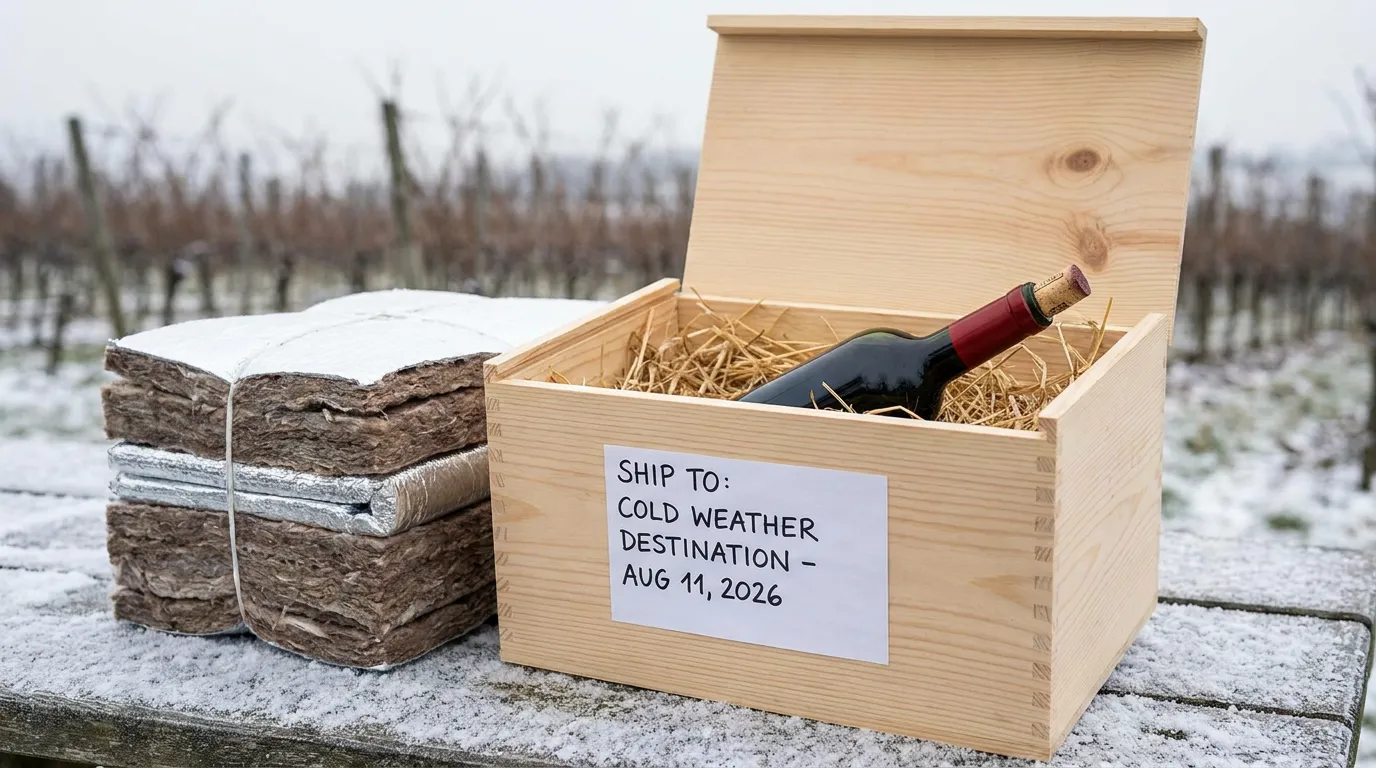
Wine is an unusually unforgiving shipment. It is heavy, it is fragile, it is often expensive, and it has a failure mode that destroys the product without breaking the packaging in any obvious way.
If you ship wine — as a winery, a retailer, a club, or just sending bottles to family — cold weather introduces a specific risk that is easy to prevent and impossible to reverse.
What actually happens when wine freezes
Alcohol lowers the freezing point, so wine does not freeze at 32°F like water. Most table wine at 12 to 14% ABV begins to freeze somewhere around 20 to 22°F. Fortified wines go lower still.
That sounds like comfortable margin until you consider overnight lows along a winter route.
When wine does freeze, it expands. The bottle is full and the only place for that expansion to go is out, which means one of two things happens:
The cork pushes up. This is the common outcome and the one to look for. The capsule bulges, the cork protrudes above the bottle lip, and the seal is broken. Once the seal breaks, air gets in. Even after the wine thaws and the cork settles back, the wine has been oxidized. It will taste flat, dull, or sherry-like. There is no recovering it.
The bottle cracks. Less common, but far messier, and it usually ruins the rest of the case along with the packaging.
The critical thing is that a frozen-then-thawed bottle can look almost normal. The customer opens it a month later and finds it undrinkable, with no idea why, and no way to connect it to a shipment. That is a lost customer rather than a claim.
The other direction is also a problem
Worth mentioning because the same shipment can face both. Wine is damaged by heat as well, starting well below any dramatic threshold — sustained temperatures above roughly 80°F accelerate aging and produce cooked, stewed flavors, and heat can also push corks by expanding the air in the bottle’s headspace.
So the safe window for wine in transit is genuinely narrow, roughly 45 to 65°F, which is why the wine trade has historically shipped in spring and fall and avoided the extremes entirely.
Carriers will not cover it
Two things to know before shipping:
Alcohol shipping is heavily regulated. Carriers require a license or approved agreement to ship wine at all, direct-to-consumer shipping rules vary by state, and an adult signature is generally required on delivery. This is not a category to improvise in.
And on damage: carrier terms typically exclude perishable goods and temperature-related damage from liability. A frozen case is your loss. Read your carrier’s actual agreement, but do not plan around a claim succeeding.
What actually works
Ship in the shoulder seasons if you can
The wine industry’s traditional answer is still the best one: ship in spring and fall, avoid deep winter and midsummer. If your business allows seasonal shipping windows, this eliminates the problem rather than managing it.
Many wine clubs simply pause shipments during temperature extremes and tell members why. Customers accept this readily, because the alternative is ruined wine.
Buy transit speed, not just insulation
Insulation slows heat transfer; it does not add heat. A styrofoam shipper in a 15°F trailer eventually reaches 15°F. Insulation determines whether that takes eight hours or twenty.
Since wine routes are often multi-day ground shipments — wine is heavy, and expedited service for a 40-pound case is expensive — the exposure window is long. Cutting transit from three nights to one is usually a bigger improvement than any packaging change.
Use molded shippers, and consider heat packs
Molded pulp or styrofoam shippers designed for wine handle both the breakage and the thermal problem better than a box with void fill. For genuinely cold routes, a 72-hour heat pack helps, with the usual caveats: it needs air to work, it should not sit against the glass, and it must be rated longer than the actual transit time rather than the quoted one.
Check the route, not the two cities
This is the step that prevents most winter freeze losses, and it is the same reasoning as will my package freeze in transit.
Because carriers move packages through hub-and-spoke networks, the path frequently crosses regions well away from the straight line. A case shipped from Napa to Atlanta in January can spend a night at a hub in the upper Midwest at 15°F. Both endpoints look mild. Nothing in the destination forecast hints at it.
For wine, where the threshold is around 20°F rather than 32°F, the margin feels generous right up until the route takes an unexpected northern detour overnight.
ParcelPath forecasts the likely path and the hourly weather at each waypoint, timed to when the package should be there, so you can see whether the low along the route actually threatens the bottles before you ship a case you cannot replace.
Time the ship day deliberately
Ship Monday through Wednesday. A Thursday or Friday wine shipment can sit at a facility through the weekend, adding two or three nights of exposure and outlasting any heat pack. See the best day of the week to ship for the mechanics.
Do not let it sit on a porch
An adult signature requirement helps here, since it prevents unattended delivery. Where it is not required, hold-at-location pickup is the better option for winter shipments. A case sitting outside overnight in January can freeze after a journey that went perfectly.
A workable cold-weather policy
- Pause or restrict shipping when routes drop below roughly 25°F for a sustained stretch.
- Check the route forecast on every winter shipment, not just the obviously cold ones.
- Ship Monday through Wednesday, never Friday.
- Molded shipper plus heat pack rated past the real transit time.
- Require signature or route to a pickup location.
- Tell customers the policy up front, including that you will hold their order during a cold snap.
The takeaway
Wine freezes around 20°F, and the damage is silent: a cork that pushed up and reseated leaves a bottle that looks fine and tastes ruined. Insulation buys hours, faster service buys nights, and neither helps if you did not know the route dipped to 18°F at a hub at 4am.
Look at the whole path before you ship a case. Forecast a route and see the low your bottles will actually see.