 ParcelPath
The Best Day of the Week to Ship a Package
Monday through Wednesday, and it is not close. The reason is that ground networks run reduced weekend operations, so a Thursday label can buy your package a weekend in a warehouse.
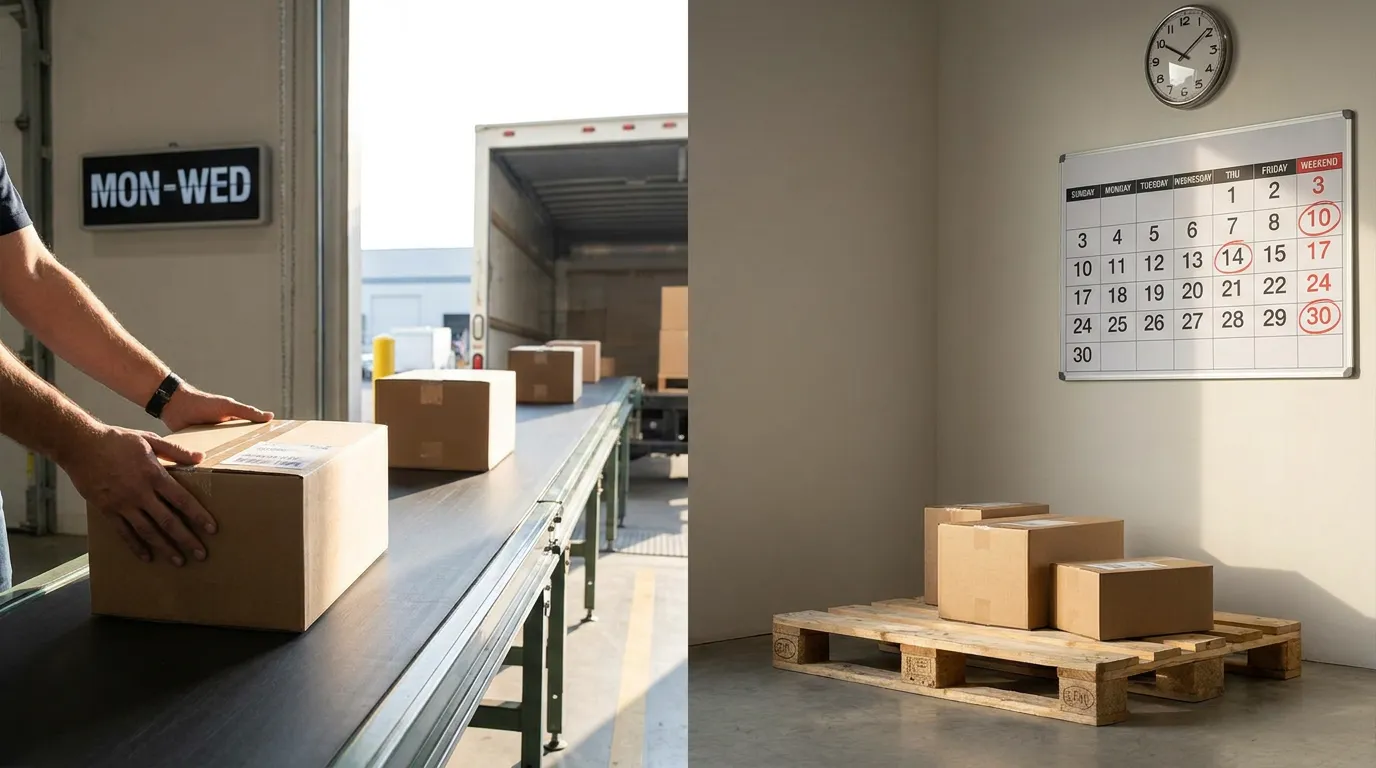
For most shipments, the day of the week you hand a package over changes the delivery date more than the distance it travels. It is the cheapest optimization available to anyone shipping regularly, and it costs nothing to implement.
The short answer: Monday through Wednesday. Here is why, and when the answer changes.
Ground networks slow down on weekends
Ground service runs on scheduled line-haul departures between hubs. Those schedules thin out considerably over the weekend, and some regional operations pause entirely.
The practical consequence is that a package which arrives at a hub on Friday evening may not move again until Monday. It is not lost, it is not delayed in any way the carrier would acknowledge, and it will not generate a single tracking scan for two and a half days. It is simply sitting, waiting for the next scheduled run.
That is how a Thursday ground label turns into a delivery six days later when the published transit time said three. The transit time counted business days; your customer counted calendar days.
Shipping Monday through Wednesday means the package’s entire journey happens inside a week where the network is running at full schedule, so the transit estimate behaves the way you expect.
The temperature-exposure argument is stronger than the speed one
If you ship anything that heat or cold can damage, this matters far more than the delivery date.
A weekend sitting at a facility is two or three extra nights of exposure to whatever the ambient conditions are. For a shipment containing chocolate, plants, wine, cosmetics, or anything perishable, that is often the difference between arriving intact and arriving ruined — and it is entirely self-inflicted, caused by a label printed on the wrong day.
It also multiplies the thermal cycling problem. As covered in shipping chocolate in summer, repeated warming and cooling degrades some products even when the peak temperature never looks dangerous. A weekend in a facility adds two or three full cycles.
And for anything relying on a heat pack or cold pack, the weekend is usually fatal to the plan. Those packs are rated in hours. A 72-hour heat pack that was adequate for a Tuesday shipment is exhausted well before a Friday shipment reaches its destination.
The rules of thumb
Monday through Wednesday is the default for ground. The whole trip fits inside the full-schedule week.
Thursday is acceptable for one- or two-day service where the package will arrive before the weekend, but risky for anything slower.
Avoid Friday for ground entirely if the contents are at all sensitive. This is the single worst common choice.
Avoid the day before a holiday for the same reason, amplified. A shipment entering the network the evening before a long weekend can sit for four days.
Monday is not always ideal for perishables in summer. If a package will be delivered late in the week, consider whether a Tuesday or Wednesday ship date puts the delivery on a day the recipient is actually home, since a package sitting on a hot porch all weekend defeats the purpose.
That last point is worth dwelling on: the goal is not the earliest delivery date, it is the shortest total exposure including the time after delivery. A package delivered Friday afternoon to an empty house sits outside until Monday.
Delivery day matters too, not just ship day
For anything temperature-sensitive or valuable, work backwards from when the recipient can actually take it inside.
- Ask for a delivery date the customer confirms they will be home for, on high-value orders.
- Offer hold-at-location pickup, which removes doorstep exposure completely.
- Avoid Friday and Saturday deliveries for perishables when nobody has confirmed they will be there.
This is the part most sellers skip. Enormous effort goes into packaging and service selection, and then the package sits in direct sun on a porch for eight hours, which was the largest single exposure of the entire journey.
When the day of the week does not matter much
To be fair about the limits of this advice:
Overnight and early-morning air service is much less sensitive to it, because the package is in the network for one night regardless.
Short regional ground moves that never touch the national hub network often run one or two days consistently, weekend included.
Carriers with full weekend residential delivery have narrowed this gap for the last mile, though the line-haul schedules that actually cause the multi-day gaps are a separate matter.
So the advice is strongest exactly where it matters most: multi-day ground shipments carrying something that cannot sit around.
Combining it with route awareness
Ship day and route are the two variables you control cheaply, and they interact.
A Tuesday shipment on a route crossing a region during a cold snap is still a bad shipment. A Friday shipment on a mild regional route is probably fine. The useful question is not “is today a good day to ship” in the abstract, but “given the path this package will take and the weather along it, is today a good day to ship this.”
Because carriers route through hubs rather than straight lines, answering that requires knowing the actual path. ParcelPath forecasts it along with the hourly weather at each stop, so ship-day timing becomes a decision based on the specific route instead of a general rule.
The takeaway
Ship Monday through Wednesday for ground, avoid Fridays and pre-holiday days for anything sensitive, and think about the delivery day as carefully as the ship day.
None of it costs anything. For sellers shipping perishables, moving the ship day is frequently a larger improvement than any packaging upgrade, and it is the first thing worth fixing. Then check the route to see whether this particular week is the right one.